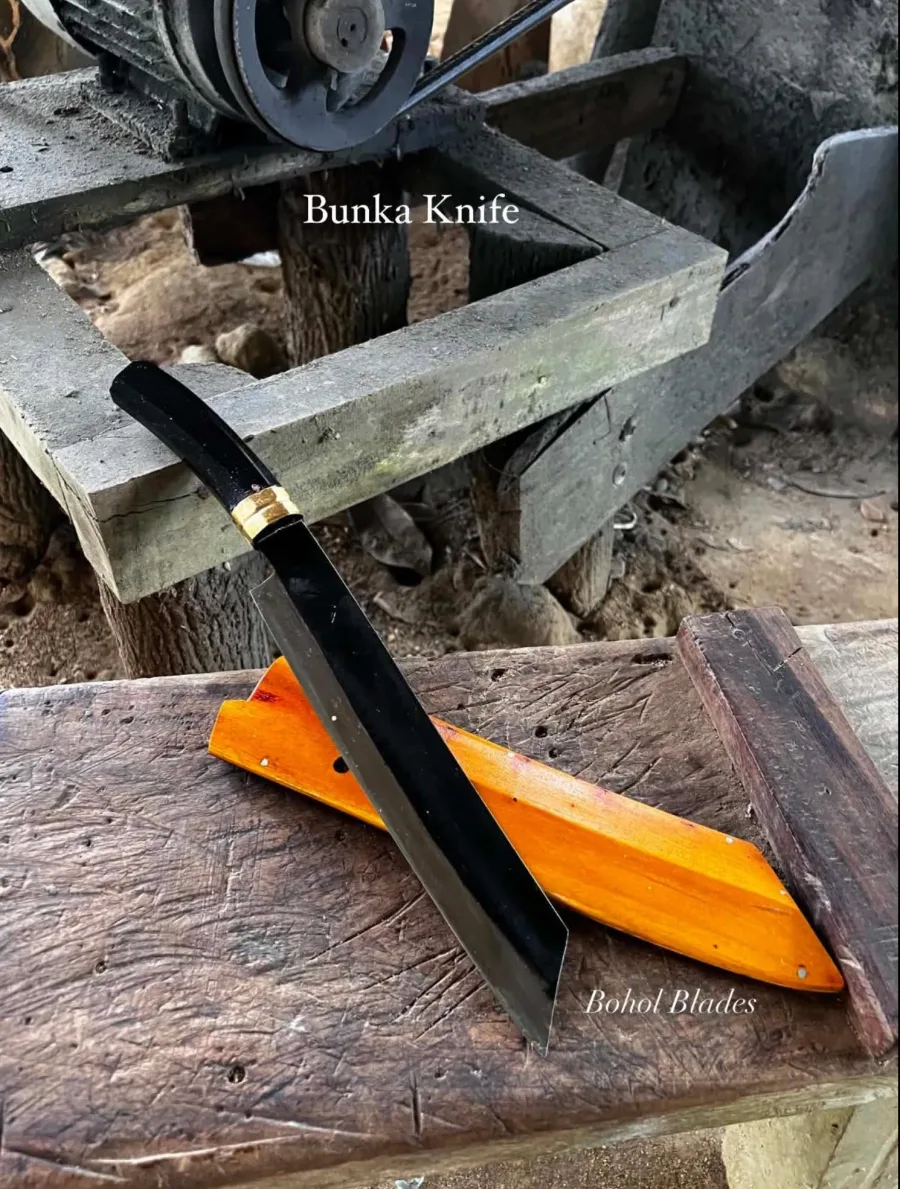
1 · The steel
Every blade starts as a leaf spring from an old Japanese vehicle. The smiths accept only the original-equipment springs, the ones that left the factory with the truck, because the alloy is consistent and the steel is clean. Favourites are the springs from Toyota Corollas and Isuzu Elf trucks. A spring has one job, to flex under load for years without cracking, and it is made from exactly the kind of medium-carbon, chromium-bearing steel a bladesmith wants: hard enough to hold an edge, tough enough to survive a chop.
The spring is cut to length, brought to orange heat in charcoal and drawn out under the hammer. Drawing the steel out, rather than cutting a profile from flat stock, lines the grain up along the edge.
2 · The horn
Carabao horn is dense, slightly translucent at the tip, and warm in the hand. A horn solid enough to carve into a handle takes twenty to twenty-five years to grow; each animal gives two. We buy from farmers when a working animal reaches the end of its life, and we buy whole, so that a set of knives can be handled from matched horn.
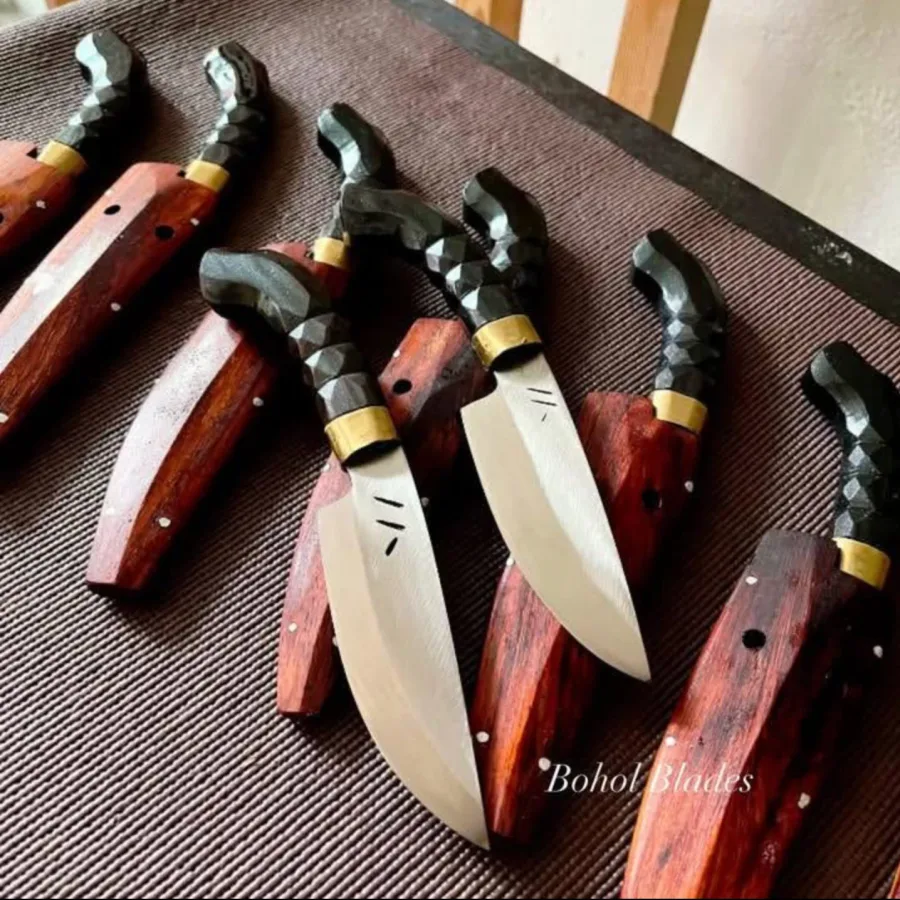
The horn is cut, drilled for the tang, carved to the shape of the blade it will carry (faceted for a kitchen set, hooked for a field knife, turned straight for a steak knife), and polished. It is seated over a brass ferrule and pinned.
3 · The wood
Sheaths and wooden handles are Philippine rosewood or tindalo, chosen plank by plank for figure. A sheath is carved in two halves to the finished blade, so each one fits its own knife and no other. The halves are pinned in brass or bronze rather than glued; a pinned sheath can be opened, cleaned and closed again in fifty years.
4 · The fittings
Ferrules, bands, throats and chapes are cut and formed from sheet brass. Pins and nails are bronze. These are expensive materials for a working knife, and in the words of the proprietor, Bohol Blades is the only shop in the province that bothers. Collectors can tell brass from aluminium across a room. So can time: brass takes a patina; aluminium pits.
5 · Hardening and tempering
After forging and rough shaping, the blade is brought to critical heat and quenched, which makes the steel glass-hard and brittle, then tempered at a lower heat to draw back just enough hardness that the edge will not chip. The smith reads the temperature by colour. Three generations of doing this by eye is the reason the blades come out right.
6 · Grinding
The bevels are ground flat and even for the whole length of the edge on a belt-driven wheel and then by file and stone. Factory knives achieve a straight bevel by setting a jig; ours achieve it because the grinder has done it ten thousand times. On black-finish blades the forge scale is left on the flats, which is both the traditional look and a layer of protection against rust.
7 · Sharpening and finishing
This is the step the shop is known for. The edge goes through progressively finer stones until it will slice a sheet of paper held in the air, which is the test Cid Cempron performs for every visitor. The blade is polished, the maker’s mark is struck by hand near the ricasso, and the handle and sheath are fitted and finished.
“These are the sharpest in Bohol. Factory knives have machines; they set their computer. Ours are handmade. No misses. The work is straight. Only we have this.”Cid Cempron, Esquire Philippines, 2022
What this means for you
- No two are identical. The horn, the grain, the hammer marks and the hand-struck stamp are different on every blade. That is the point.
- It is carbon steel. It will take a sharper edge than stainless and it will rust if you leave it wet. Wipe it, oil it, keep it in the sheath. The care guide takes two minutes to read.
- It takes about 30 days. Because it is made for you, after you order it, by people who are also making the one before yours.